Robert Capa Work (1932-1954) (Other location: Goeun Museum of Photography)
Other location: Goeun Museum of Photography
On view: June 21, 2024 - September 27, 2024
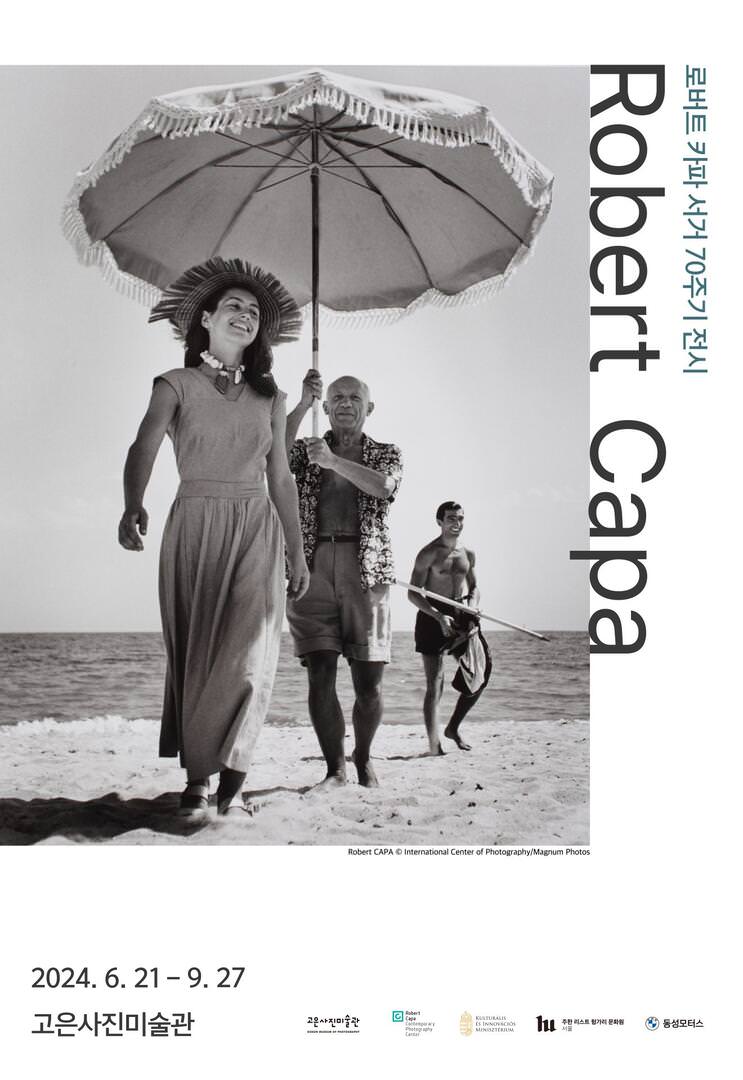
Robert Capa Work (1932-1954) (Other location: Goeun Museum of Photography)
The exhibition is a collaboration between the Goeun Museum of Photography and the Robert Capa Contemporary Photography Center.
Robert Capa is one of the most well-known photographers in the world. Working in twenty-three countries on four continents, he was not only an eyewitness to the defining historical events of the 20th century but also a messenger whose images provided a unique photographic record of the times.
The exhibition presents the photographic oeuvre in chronological order. It focuses on Robert Capa, who invented himself by observing the world around him, as well as the unique way in which he chose to make photography his profession, establishing him as a pioneer and an inescapable part of the history of photography. He could look at everything with that first ‘creative’ gaze, and whatever he touched seemed new and unprecedented. He saw what others could not. He was able to observe and think from a different perspective, which allowed him to redefine everything. His brilliant, all-pervading talent permeated all his activities and his entire life. His courage, boldness, and the visual power of his photographs are unparalleled. His unwavering empathy and humanism characterized all of his endeavors. He was, in the words of Henri Cartier-Bresson, one of the “ethical adventurers,” and the moral stance conveyed in his images serves as an example for all.
On October 22, 1913, Robert Capa was born in Budapest as Endre Friedmann, the second child of a middle-class Jewish family. In high school, he joined the left-wing progressive circle of Lajos Kassák, a leading figure of the Hungarian avant-garde. He aspired to become a journalist. His participation in a left-wing demonstration forced him to leave Hungary in 1931. He moved to Berlin, where he studied journalism at the Deutsche Hochschule für Politik (German Academy for Politics) and worked for the Dephot (Deutscher Photodienst)photo agency. In Copenhagen in 1932, he used a small Leica camera he had received as a giftto take a series of twenty-eight images of Trotsky, which the Weltspiegel published on a full page. Hitler’s rise to power compelled him to flee Germany in 1933.
Robert Capa moved to Paris, where he initially used the name André Friedmann. A year later, he met the Polish Gerta Pohorylle, and together they decided to adopt the names Gerda Taro and Robert Capa.
In 1935, he made his first trip to Spain, commissioned by the Dephot agency, and shot celebrity portraits, which later appeared in Vu and on the cover of Berliner Illustrierte Zeitung. Capa gained global recognition for his 1936 photograph during the Spanish Civil War, titled Death of a Loyalist Militiaman, Córdoba Front, Spain. However, this period also marked one of his most poignant moments—the loss of his beloved and colleague, Gerda Taro.
Death in the Making, designed by André Kertész and published in early 1938, is atouching tribute to “Gerda Taro, who spent a year on the Spanish front and never came back.”The photographs and accompanying texts depict the horrors of war, a conflict of unusual brutality in Europe that resulted in many civilian casualties. In the press coverage of the time, Capa’s photos bring the tragic events closer to the people.
In 1938, Robert Capa traveled to China to document the Second Sino-Japanese War and took his first color photographs. In 1940, LIFE commissioned him to photograph the election campaign and presidential elections in Mexico.
During World War II, he documented the events of the war. In 1941, he and Diana Forbes-Robertson authored a book titled The Battle of Waterloo Road. For the publication, Capa photographed wartime London, civilian life, and the aftermath of German air raids. He was an accredited war correspondent in the US Army from March 1943 and participated in successfuloperations in North Africa and Sicily, arriving with the Allies in liberated Naples.
His photographs were also featured in the world’s most prominent magazines, such as LIFE, Weekly Illustrated, Picture Post, and Collier’s. Stefan Lorant, the uniquely talentedHungarian-born photo editor, described Robert Capa as „the world’s greatest war photographer.”
On D-Day, June 6, 1944, he took part in the Allied operation, landing with the first American troops in Normandy. His life was in danger as was documenting the historicmoments. Although he shot several rolls of film, only ‘The Magnificent Eleven’ survived.
In 1945, he met and fell in love with Ingrid Bergman in Paris. He followed the actress to Hollywood, where he worked as an assistant cameraman and photographer. Later, he began to write his autobiography, originally intended as a movie script. The book was published in 1947 under the title Slightly Out of Focus.
The photo agency Magnum Photos was founded on Robert Capa’s initiative in 1947, two years after the end of World War II, by Henri Cartier-Bresson, George Rodger, and David „Chim” Seymour at the Museum of Modern Art in New York. Magnum Photos Inc. was the first agency founded by a group of independent photographers in the form of a co-operative, with each member holding an equal stake. The idea was to create a new kind of agency, free of the pressures of magazine journalism, allowing members to decide on which projects to work on and for how long, as well as to pertain the copyright of the photos to the authors and not the magazine commissioning or publishing them.
After the war, Capa was granted US citizenship and accompanied John Steinbeck on a trip to the Soviet Union in 1947. During the three-month visit, he took thousands of photographs of daily life in Cold War-era Russia. Later, in 1948, the volume John Steinbeck: A Russian Journal with photographs by Robert Capa was published by Viking Press.
Between 1948 and 1950, Capa visited Israel multiple times to take pictures. Hecaptured the reality of the first years of the newly founded Jewish state, including the arrival of the immigrants, their daily existence in refugee camps, and their discovery of new homes, together with all the associated expectations, joys, sorrows, and uncertainties. The photos were published in Report on Israel with a text by Irwin Shaw.
In the late forties and early fifties, the war photographer became a photojournalist when Holiday magazine commissioned him to photograph social events, entertainment venues, and world-famous artists, including the portrait series of Picasso and Henri Matisse.
Before his fateful trip to Indochina, Capa went to Japan at the invitation of the newspaper TheMainichi, which was about to launch a photography magazine called Camera Mainichi, and commissioned Capa to undertake its promotional campaign. During the six-week visit, he gave lectures, met with camera company presidents, and took photographs with equipment supplied by the magazine with no restrictions. He interacted with local photographers, gainingfirst-hand knowledge of the contemporary Japanese world. He had the opportunity to show the Asian country and its people through the eyes of someone from the West. In contrast to his war photography, the Japanese reportage is peaceful, depicting human stories and featuring a considerable number of children’s portraits.
Instead of LIFE’s assigned photojournalist, Capa went to Indochina to cover the war in the French colonies.
On Tuesday, May 25, 1954, Robert Capa and his fellow journalists escorted a French convoy from Hanoi to the mouth of the Red River. For the first time in his life, he was on the side of the occupying forces. He was doing his job as a war photographer when he stepped on a Vietnamese anti-personnel mine at 2:55 p.m. and died from his injuries shortly after.
Robert Capa lived only 41 years, but his name is among the first and best in the history of photography. In his tragically short life, he had seen five battlefields and made his mark; his photographs of the front line and the hinterlands established a school and changed photojournalism forever. He was there with the soldiers, right in the middle of action, and he documented the events in the immediate vicinity of death. This proximity and this participation recreated the genre of war photography. As his famous quote goes: „If your pictures aren’t good enough, you aren’t close enough.”
His images and works have inspired and will continue to inspire generations. Capa’s ethical principles and dedication have remained important pillars of the photojournalism profession. With his images and committed attitude, he had a profound impact on the public, contributing to a better understanding of not only history but also the specific characteristics of visual collective memory.
— GABRIELLA CSIZEK (Robert Capa Contemporary Photography Center, Curator)